
Mock trials, often utilizing PDF scripts, immerse participants in case scenarios, mirroring professional legal proceedings.
These simulations, like insurance case analyses from films, enhance understanding of criminal court dynamics.
PDF materials frequently feature real cases, such as violations of labor safety requirements (Article 143, Part 2).
Scripts outline trial structure, including opening statements and witness examinations, readily available in PDF format.
What is a Mock Trial?

A mock trial is an activity where students simulate a court trial, embodying roles like prosecutors, defense attorneys, witnesses, and judges. It’s a dynamic learning experience, placing participants at the heart of a case-based scenario, allowing them to actively work through every stage of the legal process.
Frequently, these trials center around criminal cases, and readily available mock trial PDF materials provide the foundational scripts and evidence. These PDF resources often detail specific fact patterns, such as the January 11th robbery case involving Mariafe D. Arellano, or the Westchester Square incident from May 9, 2015.
The purpose isn’t to determine guilt or innocence, but to understand courtroom procedure, legal strategy, and the presentation of evidence. Utilizing a mock trial PDF script provides a structured framework, outlining opening statements, direct and cross-examinations, and closing arguments. It’s a powerful educational tool, mirroring real-world legal scenarios, and often drawing inspiration from examples found in legal dramas like “The Rainmaker”.
The Importance of Mock Trials in Legal Education
Mock trials, particularly those utilizing criminal case PDF scripts, are invaluable in legal education, bridging the gap between theoretical knowledge and practical application. They allow students to actively engage with legal concepts, fostering a deeper understanding of courtroom dynamics and the intricacies of the legal system.
By stepping into roles like prosecutor or defense attorney, students develop critical thinking, public speaking, and analytical skills. Access to detailed mock trial PDF materials, outlining scenarios like violations of labor safety requirements (Article 143, Part 2), provides a realistic foundation for learning.
These simulations enhance comprehension of evidence presentation, witness examination, and legal strategy. The use of PDF resources ensures consistency and allows for focused preparation. Furthermore, analyzing cases like the Westchester Square incident (May 9, 2015) through a mock trial format solidifies understanding and prepares future legal professionals.
Availability of Mock Trial Materials in PDF Format
Mock trial materials, specifically criminal case scripts, are increasingly available in PDF format, offering accessibility and convenience for educators and students. Online resources provide a wealth of options, ranging from complete case files to individual witness statements and evidentiary documents.
These PDF resources often include detailed case summaries, mirroring real-world scenarios like robbery cases (January 11th example) or violations of labor safety regulations (Article 143, Part 2). The format allows for easy distribution, printing, and annotation, facilitating effective preparation.
Furthermore, many organizations and legal education programs offer downloadable mock trial PDF packages. These often include scripts outlining opening statements, direct and cross-examination questions, and closing arguments. The Westchester Square incident (May 9, 2015) is another example frequently found in available materials, demonstrating the breadth of accessible resources.

Understanding Criminal Case Structure
Mock trial PDF cases demonstrate essential elements: evidence presentation, witness testimony, and legal arguments.
Common charges, like robbery or safety violations, structure these simulations, mirroring real court proceedings.
PDF materials highlight evidence’s crucial role in building a compelling case narrative.
Elements of a Criminal Case
Mock trial criminal cases, often distributed as PDF documents, fundamentally rely on establishing core legal elements. These PDF resources typically showcase the prosecution’s burden of proof – demonstrating guilt beyond a reasonable doubt.
A key element is the actus reus, the guilty act itself, detailed within the case facts presented in the PDF; Equally vital is the mens rea, the guilty mind or intent, which the prosecution must prove through evidence like witness testimony, often transcribed in the PDF script.
PDF case materials frequently include forensic evidence, such as photography, and investigator reports, illustrating how these elements connect to the alleged crime. Causation – proving the defendant’s actions directly caused the harm – is another critical component, clearly outlined in the PDF’s narrative.
Furthermore, these PDF mock trials emphasize the importance of identifying all elements of the specific crime charged, whether it’s robbery (as in the January 11th case) or a violation of labor safety regulations (Article 143, Part 2), ensuring a complete and legally sound presentation.
Common Criminal Charges Used in Mock Trials
Mock trial PDFs frequently feature a range of criminal charges, offering diverse learning experiences. Robbery, exemplified by the January 11th case study, is a popular choice, allowing exploration of theft and potential use of force.
Cases involving violations of labor safety requirements, specifically Article 143, Part 2 of the Russian Criminal Code, appear in some PDF materials, introducing regulatory offenses. Assault and battery are also common, providing opportunities to analyze physical harm and intent.
PDF scripts sometimes present property crimes like vandalism or trespassing, focusing on damage and unlawful entry. More complex charges, such as fraud or embezzlement, may be adapted for advanced mock trials, available as downloadable PDFs.
The Westchester Square incident (May 9, 2015) demonstrates how PDF cases can center around street crimes. These PDF resources allow students to practice applying legal principles to realistic scenarios, building skills in evidence presentation and legal argumentation.
The Role of Evidence in Criminal Mock Trials
Mock trial PDFs emphasize the crucial role of evidence in establishing facts and persuading a jury. Forensic photography, often detailed in case summaries, serves as visual evidence, requiring analysis of its authenticity and relevance.
Investigator testimony, frequently included in PDF scripts, presents factual accounts of investigations, subject to cross-examination. Witness testimony – both direct and cross – forms the core of many cases, demanding careful questioning and evaluation of credibility.
PDF materials often highlight the importance of properly admitting evidence under rules of evidence, a key skill for aspiring lawyers. The January 11th robbery case, for example, would rely heavily on witness accounts and potentially photographic evidence, all detailed within the PDF.
Analyzing evidence within a PDF mock trial script helps students understand how to build a compelling case and challenge opposing evidence, mirroring real-world legal practice.

Analyzing Sample Criminal Mock Trial Cases
Mock trial PDFs present diverse scenarios, like robbery (January 11th) and labor safety violations (Article 143, Part 2).
Westchester Square incidents (May 9, 2015) offer realistic case studies for legal education.
Case Study: Robbery Case (January 11th Example)
Mock trial PDFs frequently utilize fact patterns like the January 11th robbery case, providing a concrete foundation for legal skill development.
This case centers around Mariafe D. Arellano, the private complainant, whose testimony, often detailed within the PDF script, is crucial to the prosecution’s argument.
The PDF materials typically include her direct examination, outlining her account of the events – specifically, the robbery that occurred on January 11th.
Analyzing this case study within a mock trial PDF allows students to practice direct examination techniques, focusing on eliciting clear and compelling testimony.
Furthermore, the PDF may contain potential cross-examination questions, prompting students to anticipate defense strategies and formulate effective responses.
The availability of a complete PDF script, including witness statements and potential exhibits, enhances the realism and educational value of the simulation.
Students can dissect the case, identify key evidence, and construct persuasive arguments, all based on the information presented in the mock trial PDF.
This focused approach, using a readily available PDF resource, is invaluable for honing trial advocacy skills.
Case Study: Violation of Labor Safety Requirements (Article 143, Part 2)
Mock trial PDFs often incorporate complex legal scenarios, such as cases involving violations of labor safety requirements under Article 143, Part 2 of the Russian Criminal Code.
These PDF resources provide a unique opportunity to explore specialized areas of criminal law, moving beyond typical robbery or assault cases.
The PDF script will likely detail the specific safety regulations allegedly violated, the resulting harm (if any), and the defendant’s role in the incident.
Students utilizing these mock trial PDFs must grapple with technical details and legal interpretations, enhancing their analytical skills.
The PDF materials may include expert witness testimony, such as safety inspectors, requiring students to understand and challenge specialized evidence.
Analyzing this case within a mock trial PDF format fosters a deeper understanding of regulatory compliance and corporate responsibility.
The availability of a comprehensive PDF script allows for thorough preparation and realistic simulation of courtroom procedures.
This case study, presented in a PDF, provides a valuable learning experience for aspiring legal professionals.
Case Study: Westchester Square Incident (May 9, 2015)
Mock trial PDFs frequently utilize realistic scenarios, exemplified by the Westchester Square incident on May 9, 2015, involving Ms. Jane Martinez.
These PDF case files present a compelling narrative, requiring students to analyze witness accounts and circumstantial evidence.
The PDF script will likely detail Ms. Martinez’s testimony regarding the events of that evening, including her location and observations.
Students using these mock trial PDFs must critically evaluate the credibility of witnesses and potential biases influencing their statements.
The PDF materials may include details about the surrounding environment, such as lighting conditions and potential obstructions, impacting visibility.
Analyzing this case within a mock trial PDF format sharpens skills in evidence presentation and legal argumentation.
A complete PDF script allows for a thorough rehearsal of direct and cross-examination techniques, enhancing courtroom preparedness;
This incident, documented in a PDF, offers a practical application of legal principles in a relatable context.

Key Roles in a Mock Trial
Mock trial PDFs define roles – prosecutor, defense attorney, judge, and witnesses – each crucial for a realistic simulation.
These PDF scripts detail responsibilities, fostering understanding of the legal process and courtroom dynamics.
The Role of the Prosecutor
The prosecutor, as outlined in many mock trial PDFs, represents the state or “the people” and bears the responsibility of proving the defendant’s guilt beyond a reasonable doubt.
PDF materials often detail the prosecutor’s duties, including presenting evidence, formulating a compelling narrative, and conducting direct examinations of witnesses to establish the facts of the case.
A strong prosecutor, as demonstrated in sample scripts available as PDF downloads, skillfully utilizes evidence – like forensic photography or investigator testimony – to build a convincing case.
They must anticipate defense strategies and effectively cross-examine defense witnesses to challenge their credibility and expose weaknesses in their arguments.
Mock trial PDFs emphasize the importance of ethical conduct; prosecutors must present evidence fairly and avoid misleading the court.
Ultimately, the prosecutor’s role, as defined in these resources, is to seek justice and ensure the law is upheld through a thorough and persuasive presentation of the case.
The Role of the Defense Attorney
The defense attorney, as detailed in numerous mock trial PDFs, champions the rights of the accused and works to create reasonable doubt regarding their guilt.
PDF resources highlight the attorney’s responsibility to investigate the case thoroughly, interview witnesses, and challenge the prosecution’s evidence.
A skilled defense attorney, exemplified in sample scripts available as PDF downloads, utilizes cross-examination to expose inconsistencies in witness testimonies and undermine the prosecution’s narrative.
They may present an alibi, argue self-defense, or challenge the legality of evidence obtained.
Mock trial PDFs emphasize the ethical obligation to provide a vigorous defense, even if the client appears guilty, ensuring due process is followed.
The defense attorney’s role, as outlined in these materials, is to protect the client’s constitutional rights and ensure a fair trial, striving for the best possible outcome within the bounds of the law.
The Role of the Judge
The judge, as portrayed in mock trial PDFs and scripts, presides over the proceedings, ensuring fairness and adherence to legal rules.
PDF materials demonstrate the judge’s responsibility to rule on objections, manage the courtroom, and instruct the jury on the law.
They maintain order, prevent improper questioning, and ensure both sides have a fair opportunity to present their case, as detailed in sample case files available in PDF format.
The judge’s impartiality is paramount; they must remain neutral and unbiased throughout the trial.
Mock trial PDFs often include sections outlining proper courtroom procedure and the judge’s role in guiding these processes.
Ultimately, the judge safeguards the integrity of the trial, ensuring a just outcome based on the evidence presented and the applicable law, as demonstrated in comprehensive PDF guides.
The Role of Witnesses
Witnesses are central to mock trial criminal cases, providing crucial testimony outlined in PDF scripts and case materials.
PDF examples, like the January 11th robbery case, showcase direct examination where the attorney elicits facts from the witness.
Cross-examination, also detailed in PDF resources, allows opposing counsel to challenge the witness’s credibility and testimony.
Witnesses must answer truthfully and to the best of their ability, adhering to the rules of evidence presented in PDF guides.
Their observations and recollections form the basis of the evidence presented to the jury.
Mock trial PDFs often include witness statements and potential questions for both direct and cross-examination.
Effective witness portrayal, guided by PDF materials, is vital for a compelling and realistic trial simulation, influencing the jury’s perception of the facts.
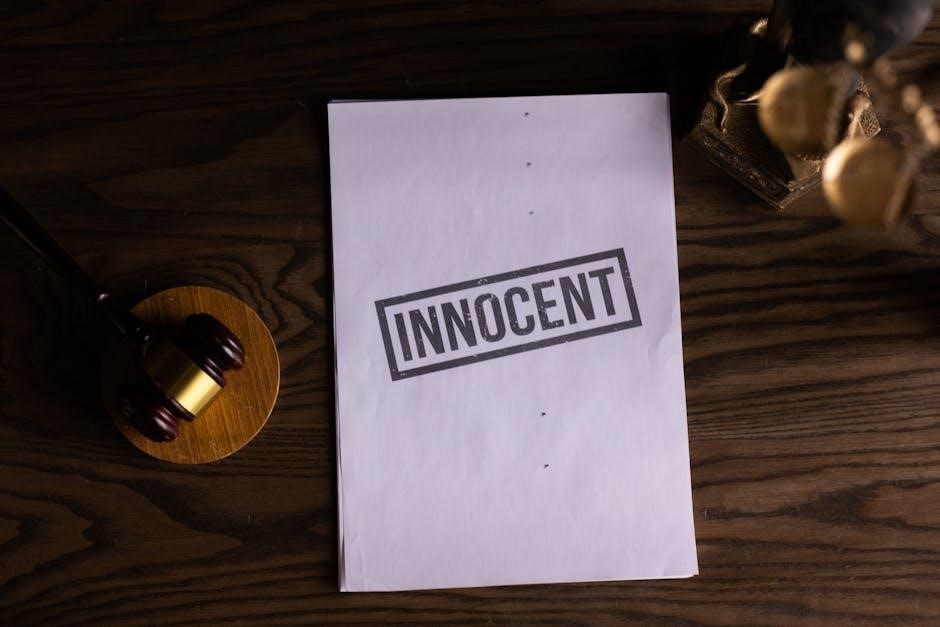
Mock Trial Script Components
Mock trial scripts, often in PDF format, detail opening statements, witness examinations, and closing arguments.
These PDF outlines structure the trial, guiding participants through each stage of the legal process.
PDF examples showcase prosecution and defense strategies.
Opening Statements: Prosecution and Defense
Opening statements, crucial components found within mock trial PDF scripts, set the stage for the case presentation.
The prosecution’s PDF-guided statement outlines the evidence they intend to present, establishing a narrative of guilt and detailing how it will be proven.
It’s a roadmap for their case, aiming to persuade the jury from the outset.
Conversely, the defense’s PDF-supported opening statement previews their counter-narrative, often challenging the prosecution’s evidence and highlighting potential weaknesses.
They may introduce alternative explanations or raise doubts about the prosecution’s claims.
Effective PDF scripts demonstrate how both sides use rhetorical devices to frame the case favorably.

These statements aren’t arguments, but rather previews of the evidence to come, carefully crafted to influence the jury’s initial perceptions.
Mock trial PDFs often include sample opening statements, providing valuable templates for participants to adapt and refine.
The quality of these statements significantly impacts the jury’s understanding and receptiveness to subsequent evidence.
Direct Examination of Witnesses
Direct examination, a core element detailed in mock trial PDF scripts, involves questioning witnesses by the attorney who called them.
These PDF materials illustrate how attorneys elicit favorable testimony, building their case through carefully crafted questions.
Questions are typically open-ended, encouraging witnesses to narrate events in their own words, as seen in robbery case examples.
The goal is to present a clear and compelling story, establishing facts and supporting the attorney’s theory of the case.
Mock trial PDFs often include pre-written questions and anticipated answers, aiding participants in preparation.
Effective direct examination, as demonstrated in PDF examples, avoids leading questions – those suggesting the answer.
Instead, it focuses on allowing the witness to recount their observations and experiences.
The examination of Mariafe D. Arellano, a private complainant, exemplifies this process, detailed in available scripts.
PDF resources highlight the importance of establishing witness credibility and laying a solid foundation for the evidence presented.
Cross-Examination of Witnesses
Cross-examination, a crucial phase outlined in mock trial PDF scripts, allows opposing counsel to question witnesses called by the other side.
These PDF resources demonstrate how attorneys challenge witness testimony, aiming to expose inconsistencies or biases.
Unlike direct examination, cross-examination typically employs leading questions – those suggesting the desired answer.
The goal is to control the witness, limiting their narrative and highlighting unfavorable aspects of their testimony.
Mock trial PDFs often provide sample cross-examination questions tailored to specific witness statements and case facts.
Effective cross-examination, as illustrated in case studies, can undermine witness credibility and cast doubt on their account.
Attorneys may focus on prior inconsistent statements, potential motives, or limitations in the witness’s perception.
PDF materials emphasize the importance of careful preparation and anticipating witness responses.
Mastering cross-examination, through practice with mock trial PDFs, is vital for a successful defense or prosecution strategy.
Closing Arguments: Prosecution and Defense
Closing arguments, detailed in mock trial PDF scripts, represent each side’s final opportunity to persuade the jury.
These PDF resources showcase how attorneys synthesize evidence presented throughout the trial, framing it in their favor.
The prosecution’s closing typically emphasizes the defendant’s guilt, highlighting evidence supporting each element of the crime.
Conversely, the defense aims to create reasonable doubt, questioning the prosecution’s evidence and offering alternative interpretations.
Mock trial PDFs often include sample closing arguments, demonstrating persuasive techniques and rhetorical strategies.
Attorneys may revisit key witness testimonies, forensic evidence, and legal principles to bolster their case.
Effective closing arguments, as seen in case examples, connect the evidence to the jury’s common sense and sense of justice.
PDF materials stress the importance of clarity, conciseness, and emotional appeal in delivering a compelling closing.
Mastering closing arguments, through study of mock trial PDFs, is crucial for achieving a favorable verdict.

Finding and Utilizing Mock Trial PDFs
Mock trial PDFs are accessible through online resources, offering scripts for cases like robbery or labor safety violations.
Evaluating PDF quality ensures realistic scenarios and accurate legal details for effective learning.
Adapt these PDFs to suit specific educational needs and skill development goals.
Online Resources for Mock Trial PDFs
Locating suitable mock trial PDFs requires exploring various online platforms dedicated to legal education and resources. Several websites specialize in providing downloadable materials for educators and students involved in mock trial competitions or classroom simulations. These resources often categorize cases by crime type, complexity, and grade level, facilitating targeted searches.
University law school websites frequently host sample mock trial materials, including complete case files, witness statements, and evidentiary exhibits, often in PDF format. Legal organizations and bar associations may also offer access to curated collections of mock trial resources. Furthermore, educational websites focusing on civics and government often provide simplified mock trial scenarios suitable for younger students.
A diligent online search using keywords like “mock trial criminal case PDF,” “high school mock trial materials,” or “college mock trial scripts” will yield a wealth of options. Remember to preview the PDF content to ensure it aligns with your specific learning objectives and curriculum requirements before utilizing it in your mock trial exercise.

Evaluating the Quality of Mock Trial PDFs
Assessing the quality of mock trial PDFs is crucial for an effective learning experience. Begin by examining the case’s realism and legal accuracy; a strong case should reflect genuine legal principles and procedures. Scrutinize the clarity and completeness of the provided materials – witness statements should be detailed, evidence logically presented, and the fact pattern internally consistent.
Consider the complexity of the case; is it appropriate for the skill level of the participants? A well-designed PDF will offer sufficient challenge without being overly convoluted. Look for balanced arguments, presenting both prosecution and defense with compelling evidence and logical reasoning.
Check for any obvious biases or flaws in the case construction. Finally, evaluate the overall presentation and organization of the PDF itself – is it easy to navigate, and are all necessary documents included? A high-quality mock trial PDF enhances understanding and fosters critical thinking skills.
Adapting Existing Mock Trial PDFs for Specific Needs
Modifying mock trial PDFs allows for tailored learning experiences. Begin by identifying areas needing adjustment – perhaps simplifying complex legal jargon for novice students, or expanding the scope of cross-examination questions. Consider adding or altering evidence to emphasize specific legal concepts or trial skills.
You can adjust witness testimonies to highlight particular evidentiary rules or courtroom strategies. If a case focuses on a specific crime, like a violation of labor safety requirements, expand related details. To increase engagement, introduce new characters or plot twists, ensuring legal consistency.
Remember to maintain balance between prosecution and defense, even when making alterations. Always review the adapted PDF for clarity and accuracy before implementation. Customizing existing materials maximizes their educational value and caters to unique learning objectives.

Specific Evidence Types in Criminal Mock Trials
Criminal mock trials utilize diverse evidence, including PDF-summarized forensic photography, investigator testimony, and detailed witness accounts—both direct and cross-examined.
These PDF resources are crucial.
Forensic Photography Evidence
Forensic photography plays a pivotal role in criminal mock trials, often presented and analyzed through PDF documents containing images and accompanying reports.
These PDFs detail crime scene documentation, showcasing the location of evidence, injuries sustained, and overall context crucial for establishing facts.
The quality and admissibility of photographic evidence are key areas for examination during trial simulations.
Students learn to assess the authenticity, clarity, and relevance of photos, identifying potential issues like tampering or improper handling.
Mock trials utilizing PDF-based forensic photography allow participants to practice objections based on evidentiary rules, such as hearsay or lack of foundation.
Analyzing these PDF exhibits helps develop critical thinking skills regarding visual evidence and its impact on a jury’s perception.
Effective presentation of photographic evidence, as outlined in PDF guides, is vital for building a compelling case narrative.
Understanding chain of custody, documented within PDF reports, is also essential.
Investigator Testimony
Investigator testimony forms a cornerstone of criminal mock trials, frequently detailed within PDF case files containing direct and cross-examination scripts.
These PDF documents outline the investigator’s role in gathering evidence, interviewing witnesses, and building the case against the defendant.
Students practicing as attorneys utilize these PDFs to prepare questions probing the investigator’s methods, credibility, and potential biases.
Key areas of questioning often focus on the chain of custody of evidence, documented in accompanying PDF reports, and the thoroughness of the investigation.
Mock trials utilizing PDF-based investigator testimony allow students to practice objection handling, challenging assumptions, and exposing weaknesses in the prosecution or defense’s case.
Analyzing the investigator’s report, often included as a PDF exhibit, is crucial for identifying inconsistencies or omissions.
Effective questioning, guided by PDF scripts, can significantly impact the jury’s perception of the evidence and the overall case narrative.
Understanding proper protocol, as detailed in PDF training materials, is also essential.
Witness Testimony – Direct and Cross Examination
Witness testimony, central to criminal mock trials, is comprehensively outlined in PDF case materials, detailing both direct and cross-examination scripts.
These PDFs provide students with prepared questions and anticipated responses, crucial for understanding witness preparation and courtroom strategy.
Direct examination, as presented in the PDF, aims to elicit favorable information supporting a party’s case, establishing facts and building a narrative.
Conversely, cross-examination PDF scripts focus on challenging witness credibility, exposing inconsistencies, and undermining their testimony.
Students utilizing these PDF resources learn to formulate leading questions, manage objections, and effectively respond to unexpected answers.
Analyzing witness statements, often included as PDF exhibits, is vital for identifying potential areas for cross-examination.
Robbery case examples, like the January 11th scenario, demonstrate how PDF-based testimony shapes the jury’s understanding of events.
Mastering these skills, through PDF practice, is essential for success in mock trials and future legal careers.